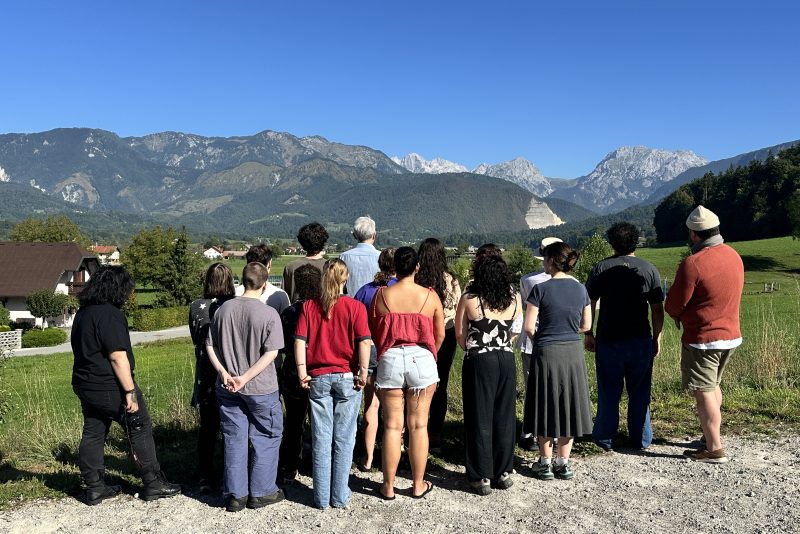
The M.A. in European, Russian & Eurasian Studies (EREAS) is a one or two-year interdisciplinary program based in the Jackson School. The degree combines regional expertise with disciplinary training, preparing students for careers in government, NGOs, business, journalism, education, or doctoral study. Students work closely with faculty across multiple departments to build customized programs focused on their specific interests within European and Eurasian studies. Below are reasons the EREAS M.A. is right for you.
Reason #1: You’re interested in studying a vast and diverse region
The EREAS program offers flexible, interdisciplinary training covering Russia, Western, Central and Eastern Europe, Central Asia, the Caucasus, and the Iberian Peninsula. All students begin with JSIS A 504: Survey of Eurasia, a five-credit course introducing scholarly approaches to studying the region, research methods, and analytical writing.
From there, you design your own course of study by selecting a major discipline (20 credits) and a minor discipline (11 credits) from fields including history, economics, political science, geography, literature, anthropology, and more. Courses may be drawn from departments across the University of Washington’s campus, including the Departments of Slavic Languages & Literatures, Scandinavian Studies, Political Science, History, Economics, Geography, and more.
Reason #2: You want to develop proficiency in languages like Estonian, German, or Russian
Language study forms an essential part of the program. Students must demonstrate second-year proficiency in their primary research language, though you don’t need to arrive with prior training. Many students complete the full language requirement during the two-year program.
The Jackson School and partner departments offer regular instruction in most major modern languages from European and Eurasian regions. Intensive summer programs also allow students to complete a full year’s language work in one quarter.
Reason #3: You plan to conduct research, travel, or work in Europe or Eurasia
Understanding the historical, cultural, and political contexts of European and Eurasian societies opens doors to meaningful engagement abroad. Students completing the thesis option undertake major research projects involving extensive use of primary sources, typically producing 20,000-word dissertations, whereas those in the two-paper option complete two 8,000-word research papers, one of which must be original empirical analysis aimed at scholarly or policy audiences.
The Jackson School’s Ellison Center for Russian, East European and Central Asian Studies and Center for West European Studies provide additional resources, including speaker series, conferences, funding opportunities, and study abroad opportunities.
Ready to learn more?
Applications are due January 31 for admission to the 2027 autumn quarter cohort. The program only admits students for autumn entry.
“Come to the Pacific Northwest, to Washington state, to Seattle,” Guntis Šmidchens, the director for the Center for European, Russian, and Eurasian Studies (CEREAS), said “Come study at the Center for European, Russian, and Central Asian Studies at the University of Washington.”
Questions? Email Graduate Program Adviser Jesús Hidalgo at jsisma@uw.edu.