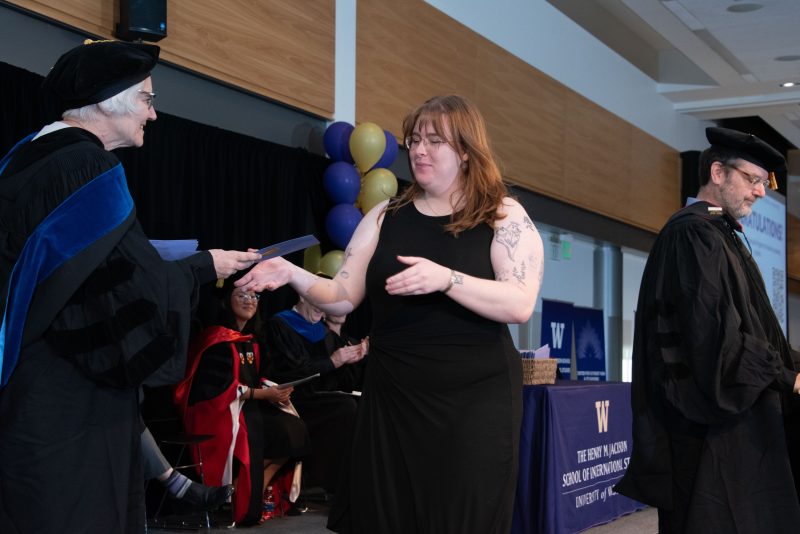
Mai Kearney arrived at the Jackson School with a question that had taken shape half a world away: how do political systems respond when history suddenly shifts?
The question emerged in 2022, when Kearney was living in Japan and witnessed the shockwaves that followed the assassination of former Prime Minister Shinzo Abe. Kearney spent a year in Japan as an assistant language teacher through Japan Exchange and Teaching (JET) Program.
After moving back to Seattle later that year, Kearney sought the tools she needed to transform observation into analysis, applying for the Jackson School’s new M.A. in East Asia Studies in 2025.
“[Abe’s death was] maybe like a dark catalyst, but it definitely was a catalyst for wanting to know more about political behavior in Japan,” Kearney said. “So after I moved back, I looked into UW programs that I felt were fitting [for] that academic interest.”
The program’s interdisciplinary structure provided what Kearney needed. Coursework in East Asian politics combined with faculty mentorship — especially under Professor Robert Pekkanen — helped build analytical tools for understanding one of the world’s most complex democracies.
Kearney chose the program’s one-year option, completing her degree in an accelerated timeline. She also opted to write two article-length papers that allowed her to dive deep into specific topics instead of the traditional thesis.
“One of them was about Shinzo Abe and his career as prime minister and how he used the issue of the North Korean abductees to further his political ideology,” Kearney said. “The other paper that I wrote was about the Japanese legal system and how religious groups, specifically new religious groups, are prosecuted and also treated socially. Using the case study of Shinzo Abe’s assassination, the man who assassinated Shinzo Abe, his reasoning was that Shinzo Abe helped promote the Unification Church in Japan, which is like a cult [and] new religious movement from South Korea.”
A longstanding connection
For Kearney, her interest in East Asia stretches back much further than graduate school.
“In Washington [state] and in Seattle, we have such a great cultural connection to Asia as a whole,” Kearney, who was born and raised in Seattle, said. “Just being divided by that ocean .. I was always surrounded by Japanese culture and East Asian culture.”
This past spring, Kearney graduated as the program’s inaugural M.A. recipient, marking a milestone for both student and institution.
“There is always, in anything, a little bit of a good feeling — a little pat yourself on the back — when you find out you’re the first,” Kearney said.
The Jackson School designed the East Asia Studies M.A. for students like Kearney: those seeking rigorous regional expertise that bridges academic and professional worlds. The flexible structure, with options for one-year or two-year completion and thesis or non-thesis tracks, accommodates different career timelines and goals.
Applications for the M.A. in East Asia Studies, as well as five other graduate programs at the Jackson School, will close Jan. 31, 2027. For more information, email jsisma@uw.edu.