Senior military officers and academic scholars don’t always share the same classroom. At the Jackson School, however, they do. Since 2015, the University of Washington Army War College (AWC) Fellowship has brought 20 Army leaders to campus for a year of immersive study, creating a space where operational experience meets academic rigor.
The AWC Fellowship grew from a conversation between then-Jackson School Director Reşat Kasaba and Lieutenant General Stephen R. Lanza, former Commanding General at Joint Base Lewis-McChord. Recognizing the military’s increasing focus on the Pacific Rim, Lanza suggested leveraging the Jackson School’s regional expertise to educate officers on Asia. When selected in 2015, the University of Washington was only the second university on the west coast with such a fellowship, joining Stanford University.
“This fellowship serves as a strong step toward bridging the still fragile military-civilian divide in the U.S., Washington state, and UW,” Abby E. Murray, the fellowship program coordinator, said. “AWC fellows and students spend a year working together on campus, and the result is the sharing of ideas and a healthy evolution of perspectives.”
The 2025-2026 cohort exemplifies the program’s depth: Colonel Jason M. Shick brings 22 years of Army experience, including combat deployments to Iraq and Afghanistan and recent work with Security Assistance Group-Ukraine. Lieutenant Colonel Deanna Manriquez contributes 24 years of service, including aviation leadership in the Hawaii National Guard and disaster response efforts during the Kilauea lava emergency and Hurricane Lane.
The program culminates in an annual spring presentation; this year, on May 12, fellows had the opportunity to present their final research papers to members of the Army War College, the Jackson School, and the Henry M. Jackson Foundation.
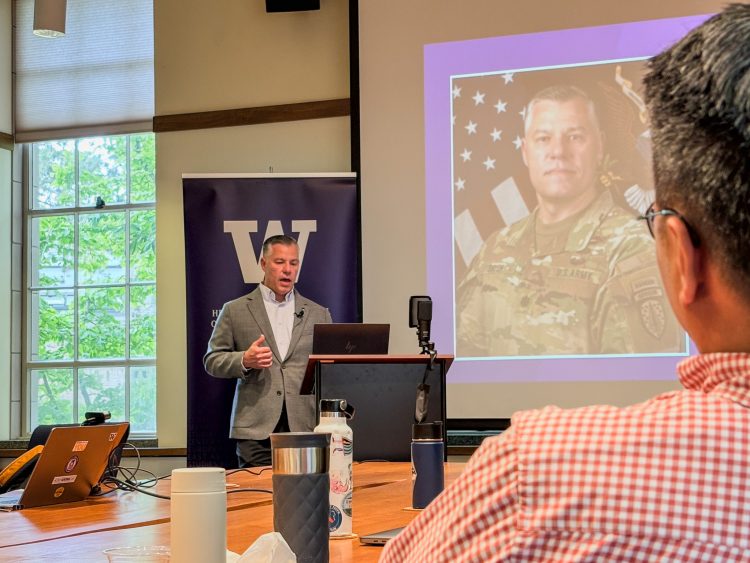
Colonel Jason Shick presents his report, “Deterrence through Modernization: Integrating U.S. and Domestic Weapon Systems into Taiwan’s Ground Forces” on May 12, 2026. Photo by Madison Morgan
Shick’s report, written under the supervision of Associate Professor James Lin, examined Taiwan’s ground forces modernization, analyzing how integrating U.S. and domestic weapon systems can enhance deterrence against Chinese coercion.
Manriquez, who worked alongside supervisor Professor Saadia Pekkanen, explored the Army’s growing dependence on AI, investigating how increased reliance on artificial intelligence may impact critical thinking skills among future military leaders.
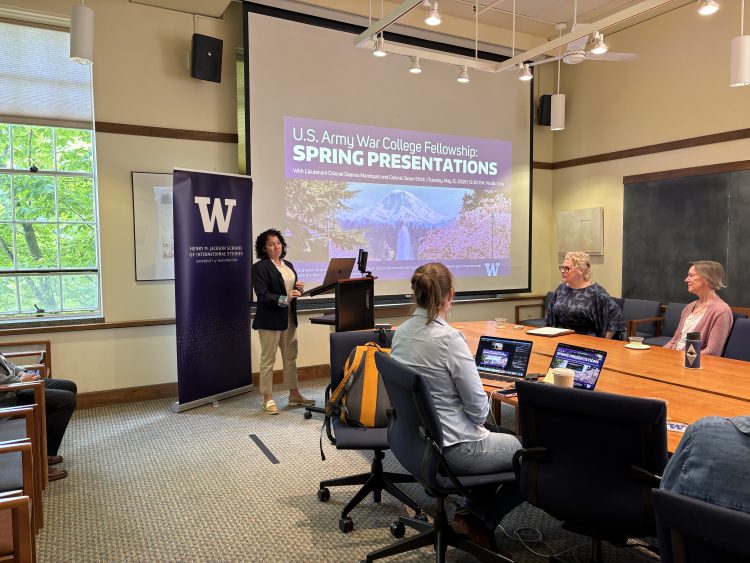
Lieutenant Colonel Deanna Manriquez presents her report, “Critical Thinking and the Army’s Shift to AI Dependence” on May 12, 2026. Photo by Madison Morgan
The Army War College Fellowship shows what the Jackson School does best: bringing different perspectives and communities together. This year’s research tackles urgent issues, from Taiwan deterrence to AI dependence, proving the program’s value in preparing leaders for today’s security challenges. Through these collaborations, the Jackson School builds lasting bridges between military and civilian communities while equipping decision-makers with the skills needed to navigate a geopolitically complex world.