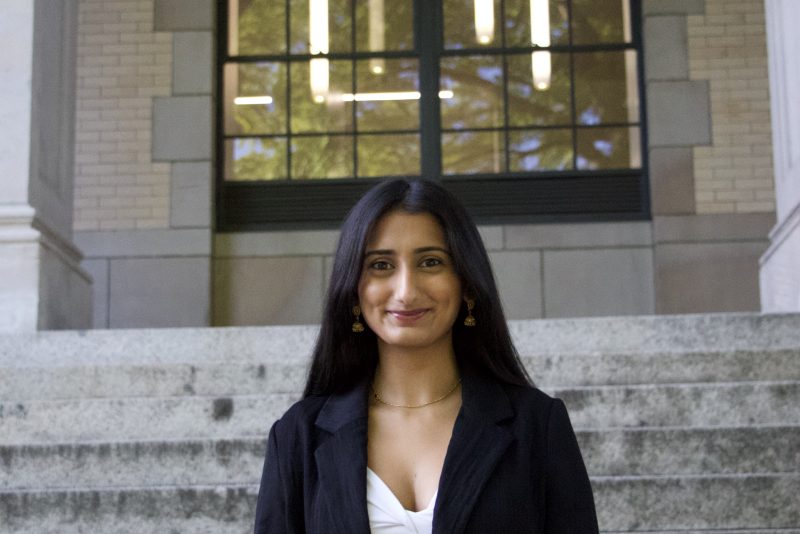
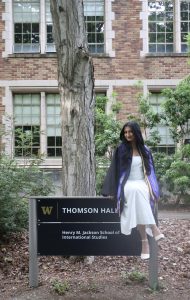
Sejal Antal in front of Thomson Hall.
Sejal Antal is an international studies and political science major and human rights minor in the graduating Class of 2026.
During her time at UW, Antal performed various leadership roles at the Jackson School Student Association, conducted field research in Peru, served as a Task Force project manager in Rome, Italy, and completed internships in law and legal research that eventually culminated in presenting at the United Nations Office at Vienna.
We sat down to discuss her reflections on student leadership and academics at the Jackson School, and her career path after graduation. Here’s what she had to say:
What did you learn from your experience in the Jackson School Student Association (JSSA)?
I committed to the International Studies major my first quarter at UW, so I’ve been on this track all four years … so I think that it’s been really formative to have, to know early on that this is the track I wanted to go on, because I was really able to put down some roots that first year and build off of that … until my junior year I was Director of Academics, and Vice President, President Elect, and then this year I’m President … another thing I’ve noticed is that everyone leads differently, everyone has their own ways of doing things, so being able to put my own spin on things this year has been really fulfilling as well. I feel like taking lessons over the last four years from everyone else has really helped me, but I think that overall JSSA has been my guiding force these last few years, just because a lot of the opportunities I think that I’ve been able to do have either come from, somehow I’ve learned about it through someone in JSSA, or when we put on an event, or through a professor … working to build that kind of community within the Jackson School has been a big part of my undergrad career, and also has really guided me through the extracurricular process and my other accomplishments as well.
What courses have you taken that were standouts for you?
There was a JSIS class I took my sophomore year called Luzo-Brazillian Cultures. That class was amazing because it was so small … we learned so much about Afro-Brazilian culture, and then just post-colonial Brazilian culture as well, through the lens of just music, and I think that was one of the most unique classes I’ve been in, and the professor was very interested in it as well, because you know he’s very familiar with his music … Another class that really stood out to me is actually what I’m in right now, so it’s Women [and International] Economic Development … with Dr. Ramamurthy, and I think this class is really important because it’s the first time I’ve been in a class that’s really addressed the colonial impacts of on women in India and South Asia, so I haven’t taken a lot of South Asian focused classes because my concentration was in Latin America … but I’m, my family’s from Punjab in India, and there’s just a really violent history there that’s just really not talked about, because a lot of the culture is more like a forgive-and-forget culture, so you know, there’s just not a lot of discussions, and before this quarter I had never heard someone talk about Sikh genocide, or just, the Sikhi faith in general in an academic setting before … I was like, ‘is this real right now?’ Like, I only ever heard this talked about in my, with my family or at the summer camp that I work at, and so I think having, listening to her put this all into an academic lens and connect it to all these theories that I’ve spent four years learning was really full circle for me, because I was really able to finally make this connection that I’ve always wanted to, of my cultural background and my family’s background with my academic interests as well. So the couple weeks that we were focusing on North India was really special, and I think it’s something I’ll probably carry with me for a long time, because I think just shedding light on that kind of topic as well was really important for me.
How did your interest in human rights law and humanitarian work develop?
The summer after my freshman year, I got really lucky and got this internship with the Clark County Volunteer Lawyers Program, which is a legal aid nonprofit, and they serve low-income and marginalized communities in Vancouver, Washington who need legal aid and representation for no cost … that’s where I started thinking about law as more of a pathway, or possible pathway for me, and then I would say international human rights systems, more cultural classes, and taking some classes on immigration and things like that, I was able to narrow into this legal focus and see how it intersects within all these different subjects. So I think with— that internship combined with all the work that I’ve been able to do with [Dr. McCloskey] has really opened my eyes to … being a foreign service officer isn’t the only pathway for me, there’s more I can do. And I think the Jackson School and JSSA does a really good job at trying to introduce students to those kind of possibilities as well … Right now I’m definitely on the pre-law school route. I take the LSAT next week, so it’s a little bit freaky, but yeah, feeling a little bit nervous, but it’s gonna be okay. And then applying this next fall to start next year, so that’s the path I’m on, and I’m definitely more leaning more towards the legal aid, nonprofit side of the work, and that’s what I also hope to spend my gap year doing as well. Because I think outside of research, the legal aid work that I did, I felt the most connected to. I think that was really important. I really felt like there was some meaningful things happening in that field.