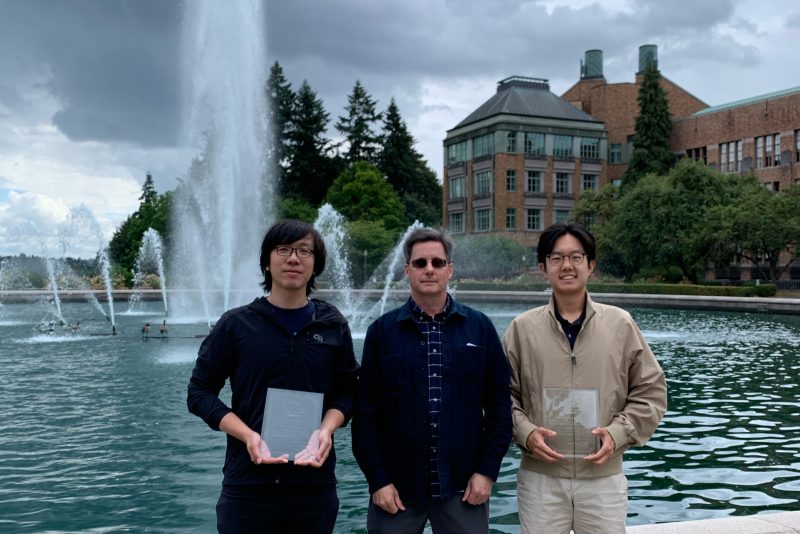
Department of Mathematics Ph.D. graduate Herman Chau and current candidate Michael Zeng, alongside Professor and Japanese Program Coordinator Paul S. Atkins, received the Jinmonkon 2025 Best Paper award for their paper, “Deriving Orthographic Data from Classical Japanese Texts with Machine Learning Methods.” Chau also received the Student Encouragement award as the student first author.
Chau and Atkins presented the paper at the 2025 Jinmonkon Humanities and Computers Symposium, held on Dec. 13-14, 2025, at Kyushu University in Fukuoka, Japan. The symposium focuses on the application of computers to the humanities.
Chau graduated from UW with a Ph.D. in Mathematics in December 2025. Zeng is a current UW Mathematics Ph.D. candidate, advised by Sara Billey and Jarod Alper. Zeng is also a current Director of the UW Math AI Lab, a research and education organization at UW dedicated to using AI for math. Atkins is a Professor of Japanese and the Japanese Program Coordinator in the Department of Asian Languages and Literature at the University of Washington.
Research Background
Chau, Zeng and Atkins’ research applies machine-learning techniques to extract orthographic data — the written, visual representation of language — from classical Japanese texts. Hiragana is one of the phonetic scripts that written Japanese uses to represent the sounds of the language. Hiragana characters derive from jibo, base Chinese character forms rendered in cursive. In modern Japanese, a single hiragana represents each sound based on a single Chinese character. Before 1900, each sound could be represented by multiple hiragana, each derived from a different Chinese character.
Because scribes’ handwriting varied, jibo can carry evidence of who copied a given text. Chau, Zeng and Atkins’ models identify jibo in classical texts, helping attribute scribes and provide deeper historical insight. These processes previously required extensive manual effort.
Building Bridges Between Deep Learning and Humanities
Chau, Zeng and Atkins hope their research will lead to greater understanding within the broader study of classical languages, greater representation of humanities in academic conversations about AI and the elimination of some of the manual labor previously required with scribal attribution.
“It is immensely gratifying to see that bringing mathematics into the study of language in the form of digital humanities opens the door to new discoveries inaccessible by previous methods,” Zeng said.
Group collaboration is less common in literary scholarship than in the sciences, but Atkins recommends it to any humanist who has the chance.
“Literary scholarship is ordinarily solitary work: one sits with a text, alone, for years,” Atkins said. “This project has been the opposite of that, and it was fun from beginning to end. Herman and Michael brought skills I do not have and asked questions I would not have thought to ask, and the three of us were of one mind about where the project should go, which is not something I had any right to expect.”
Access Chau, Zeng and Atkins’ dataset here.