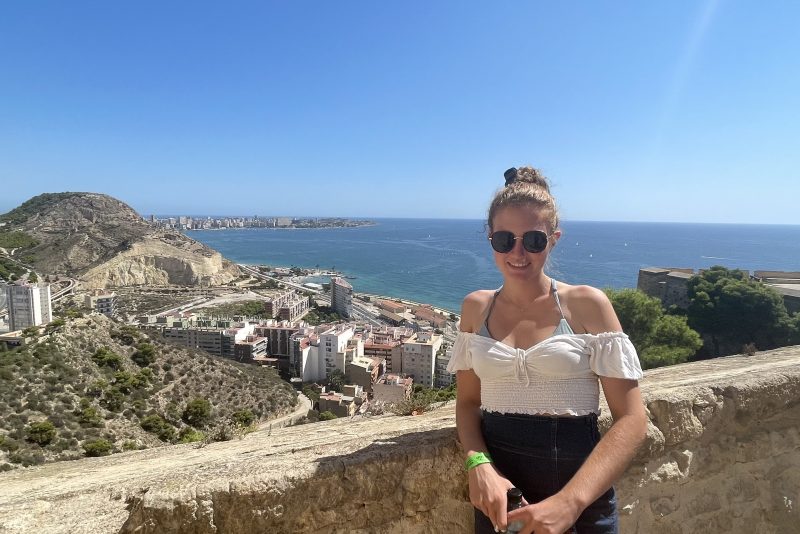
The path to meaningful environmental work doesn’t always follow a straight line. For Tessa Marks, it began in a Santa Cruz classroom where Spanish echoed through the hallways, continued through a biochemistry lab, and now leads to the mangrove forests of Honduras’ Bay Islands.
Marks — a dual master’s student in marine affairs and international studies with a focus on Latin America and Caribbean Studies — has been awarded a Fulbright U.S. Student Program Research Award. She will spend the 2026-27 academic year in Roatán, Honduras examining the social and ecological complexities of mangrove forest resilience and restoration efforts.
Growing up in Santa Cruz, California, Marks found herself surrounded by Spanish speakers. That early exposure sparked a curiosity that led her to volunteer in Peru while still in high school, pursue a Spanish minor as an undergraduate, and study abroad in Spain. Along the way, she developed a deep appreciation for Latin American and Caribbean ecological and cultural diversity, even as climate change increasingly threatens the region.
Her Fulbright project combines earth science, spatial analysis, policy research, and community engagement to understand mangrove protection and restoration in the Bay Islands. Working with the Bay Islands Conservation Association on the island of Roatán (the biggest of the Bay Islands), she plans to develop an interactive mapping tool that visualizes mangrove coverage alongside environmental stressors and social pressures.
More than maps, centering local knowledge
Marks emphasizes that data alone won’t drive change. A central component of her project involves connecting with local practitioners and stakeholders whose experience offers invaluable insight into how mangrove ecosystems are valued and protected.
“By sharing their stories and tying them to the landscapes they help shape, I hope to improve our understanding of how governance, community, and ecology interact to shape ecosystem health and human well-being within the Bay Islands,” Marks said.
Courses at the Jackson School taught Marks to look past ecological outcomes alone and into the social, political, and historical contexts from which they are inseparable. Being a joint student with the School of Marine and Environmental Affairs allowed her to build an academic path tailored to her interests.
“My path here was not necessarily a traditional one,” Marks, whose undergraduate degree in biochemistry initially led her to a research scientist position with the University of Washington, said, adding that “Had I stayed within the boundaries of my degree focus, I would never have gotten the opportunities I have today. One of the things I value about the Jackson School is that it encourages interdisciplinary thinking and empowers students to carve a path that best suits them.”
She believes this approach has broader implications.
“If more people from different backgrounds applied their expertise in unfamiliar contexts, we could open doors to finding better, more creative, more comprehensive solutions,” Marks said.
Beyond Honduras and the Fulbright
Following graduation in fall 2027, Marks plans to gain more professional experience before committing to a Ph.D. program.
“I expect that the relationships I build, the experience I gain, and the lessons I bring home from this fellowship will play an important role in shaping the next steps in my career,” she said. “Merging the education I’ve gained in these degrees and my technical skills from my background in chemistry and molecular biology, I hope I’m able to effect real change in how we understand and manage marine ecosystems.”
The Fulbright U.S. Student Program provides grants for individually designed projects for U.S. graduating seniors, graduate students, young professionals and artists to study, conduct research, or teach English abroad. This year, seven University of Washington students and recent alumni were awarded Fulbright scholarships. Besides Mark, Jackson School minor Tin Pak also received a Fulbright to study at National Chengchi University in Taiwan.