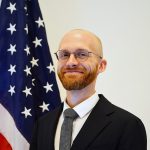
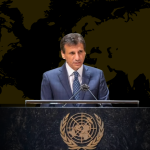
Danny Hoffman: Welcome, everyone. My name is Danny Hoffman. I am the director of the Henry M Jackson School of International Studies here at the University of Washington. It is the third of November 2026. This is the latest in a series of ad hoc podcast interviews we’ve been producing from the Jackson School. I would encourage you to take a moment and listen to some of the other programming that we’ve done in our various centers and programs the Global Sport Lab, comparative religion, Latin American Studies, and then of course, also conversations coming from the school as a whole. Now, I’m delighted today to have the opportunity to welcome and interact with His Excellency, Doctor Mohammed Al Hassan. He has been kind enough to join us for a few days here in the Jackson School, gave a fantastic fireside chat with myself and Doctor Asli Cansunar, the director of the Middle East Center. Um, that talk is archived on our website. I would certainly encourage you to to have a look. We covered a lot of interesting territory. And today we’re going to have a conversation that’s a little more focused on diplomacy. Now, before we jump into that conversation, just a reminder that we record all of these podcasts in the attic of Thompson Hall. So you are likely to hear the strange noises of an old building and an active university campus outside our window. Now, my guest today, as I mentioned, is has led an absolutely fascinating, incredible career in global diplomacy. Doctor Mohamed Al-Hassan was, until very recently, the Special Representative of the Secretary General and head of the United Nations Assistance Mission for Iraq, or UNAMI, from October 2024 until just recently. Prior to that, he was the Permanent Representative of the Sultanate of Oman to the United Nations, a post that he took up on the twenty first of August 2019. During his time serving in the UN, he served as the Vice President of the seventy fourth session of the United Nations General Assembly and has held a number of other posts within the UN of high importance. He has, prior to stepping into the UN, he had a very distinguished career already in the Omani Foreign Service, serving as acting undersecretary for diplomatic affairs at the Foreign Ministry of the Sultanate of Oman and having served as ambassador from. Of the Sultanate to the Russian Federation from 2009 to 2012 which was a residential post. But then also he concurrently held the position of non-resident ambassador, ambassador to the Republic of Belarus, the Republic of Ukraine, Republic of Armenia and the Republic of Moldova. He also then, of course, served in the Foreign Ministry in Oman as well. So a very distinguished career, and he has had an interesting educational path to get there, one that I think is particularly interesting for us. His PhD is in economics from Moscow State University. He holds a master’s degree in international relations from Saint John’s. But the highlight of all of that is that he is actually a proud University of Washington undergraduate bachelor in political science. So, uh, ambassador, welcome home and thank you for being here.
H.E. Amb. Mohamed Al-Hassan: Thank you for having me. It’s great. It’s always happy to be back in Seattle. Well, it’s, it’s been, it’s been great fun for us to be able to host you back here. And I want to thank you. We’ve we’ve really put you through your paces. I imagine that being an international diplomat, you get used to long hours and a lot of meetings back to back. But you’ve been a good sport about lots of class visits and lots of engagements with students and our faculty. So thank you.
DH: Absolutely. So, um, as I, as I mentioned, um, the, the impetus for our conversation is that we in the Jackson school have a lot of students, not all of our students, but many of them come in either imagining that they might want a career in diplomacy or that they plan to work in fields for which they will be engaging with diplomats. They may be in the security services, they may be working in NGOs. They may be doing practicing law journalism, but their worlds will intersect with the worlds of international diplomacy. And so I wonder if you when you think back, um, especially the early parts of your career, what do you think it was that best trained you or prepared you for the life that you’ve led in diplomacy?
MAH: Frankly speaking, it’s a very good question. And it takes me back years back to the time when I was here at the University of Washington. At that time, I never thought of, uh, following the path of this career, frankly speaking. But when I went back to my country, I found the opportunity. They were looking for people who speak languages. And it happens that I do speak some foreign languages beside Arabic. And it became very handy. It’s a career that I’m very proud of. It’s different than the the political career. It’s a diplomatic career. And the best part of it is when you work with and within the United Nations, there are so many good things that you can contribute to a better world. The last of which was being in Iraq, supporting and helping the Iraqis move beyond the zone of conflict to a normal state with active political system and an engaging country.
DH: Now, I want to I want to drill down a little bit in this, because I’ve heard you over the last two days, also mentioned the, the language, um, piece as a really important component of what it means to, to engage in negotiation, to be, to be a diplomat. And I wonder if you would say a little bit more about that. And maybe also because this is one of the contexts in which it came up, the question around technology advances in technology, right? I do think there’s a lot of concern for those of us that are in the business, in part of teaching languages that students today or the general public will say, well, you now have tools that can do almost instantaneous translation at a very high level. So what, what, what is changing about the diplomatic career? Like why, why, why would languages be the first thing that would come to mind? And is that still the same as when you began your career? Or has the nature of diplomacy changed as the technologies have enabled a different kind of of interaction?
MAH: It’s a very interesting question. And technology is changing our lives on a daily basis. Now we are in the phase of artificial intelligence. And this is not the end of innovation, of new technologies coming. But when it comes to languages, you don’t learn the language itself. See, when I was here at the University of Washington, I found a golden opportunity to take one of the programs through the University of Washington and study Norwegians in Norway. So I did not learn the Norwegian language. I learned Norwegian language, Norwegian culture, way of life. What makes them happy? Their folks. Their culture. So many things. So this technology cannot provide all of that. And by immersing a student, immersing herself or himself into the language phase, it’s not as automatic as a language. It is a language plus, you know. And it’s very enjoyable, very interesting. Uh, some Memories that are associated to that country. So, frankly speaking, pursuing a path to learn languages. Uh, it’s, it’s a whole collection of things. And that’s why I advise people, uh, to go beyond the technicality of languages and try to measure in a, in a language and the culture of that language and the history of that language and what, uh, and visit the countries that speak those languages. Because when you do that, you will understand this is beyond an automatic mastering of words. It’s way beyond that.
DH: You, you hinted at this, but I want to unpack it a little bit more. I’m assuming that you didn’t go to Norway with the idea that at some point you were going to be Oman’s ambassador to Norway, right? It was, you know, that an opportunity presented itself. You took it. You know, you immersed yourself in a new a new culture. But I think a lot of our a lot of our students, especially maybe at the undergraduate level. Um, there’s a real pressure to say, well, how, if, if I do, if I take this opportunity, it’s going to lead to this outcome. And that kind of the pursuing a path that opens itself for the pleasure of, of, of the path, right? Or for just something that’s different to them. It sounds like that’s kind of what you did. Um, so I guess what maybe a way to ask this is when you are would advise a student today who might have an opportunity, you know, how much do you advise them that you should be thinking about what the career path is that comes after this? And how much are you saying this is just an amazing opportunity to be immersed in something new? And that’s that’s enough of a goal in itself. It will eventually lead to something, but it will be something you can’t predict. Is that a is that a fair question?
MAH: It is a fair question. And frankly speaking, um, me choosing Norwegian at the University of Washington as a foreign language to study, was very far away from the expected language. I would learn either English or French or Persian or Turkish or Hindi, uh, closer to, uh, the language that are very common within the Middle East. Uh, but my, uh, choice of language was based on something beyond. I want it to be unique, probably being the only Omani who can speak Norwegian, which happens to be that case. And, uh, was not very positive because I could not really communicate with anybody in Oman. There were not Norwegian word ups in most of Norwegian, not even Norwegian embassy at that time. But frankly, it really gave me an access to the Norwegian culture. And it’s, uh, my focus was mainly trying to do a comparative study analysis between the Bedouin women in Oman, the nomadic women in Oman, and the Sami women, because they also have reindeer herds. And that and that research really took me much further into getting more about the Norwegian and Scandinavian culture. And every time I sit at the United Nations, you know, we sit alphabetically. So all comes after n Norway. So but after the Norwegians sit down and they start communicating privately with themselves. I look at them and I say, I heard what you said in Norwegian, and they get shocked. Say, what a Bedouin learn in our language.
DH: That’s fantastic.
MAH: It’s interesting. It’s. I really get to love than to love the Norwegian culture. Norway as a beautiful country and also engaged even in my future diplomatic career with the Norwegian institutions, not only Foreign Ministry, but also some of the mediations. Because if you know that Oman is a country that is focuses on mediation, also Switzerland and Norway does that. So learning the language made our connection much closer with with the Norwegians especially.
DH: That’s great. And again, I imagine that’s not something that as a as a young man, you know, in your your college days that you were necessarily thinking about. Right. But it sort of it emerges organically over the course of a lifetime, just pursuing these great opportunities.
MAH: It really opened a lot of opportunities for me, not only in Oman, but also in Scandinavia. But, you know, my choice was to come back to Oman and help my country and my countrymen when it comes to diplomatic areas, and I hope I did made make some contributions to that.
DH: So I want to I want to ask a question that I know a lot has has been on a lot of our students minds when I’ve had the good fortune to speak with diplomats or people that have had diplomatic careers. Um, this is a question that that frequently comes up for our students. And I, it, I say this recognizing the particular moment that we’re in in the United States. And that’s really the frame of reference for this question. But I’m I’ve heard American diplomats speak to this. And now I would love to hear your take on it. So, you know, one of the things that our many of our students who imagined a career in diplomacy or had hoped for one prior to our current administration is, um, they worry now about what might happen if they are called on as representatives of a nation to represent ideas that they don’t agree with. And I think there’s a particular strain of this, where in a moment when we see globally a rise of a certain kind of authoritarian regime, a certain kind of populist politics that many of our students, um, I think it’s, it’s, it’s raised for them. The question that probably has always been a part of the, the, the diplomat’s conundrum, but I think maybe more pronounced now where, um, you’re called on to represent a, a system that perhaps you either an individual idea or a system as a whole that one one finds, um, less comfortable to represent. So I guess I’d love to hear what you think about the diplomat’s role vis a vis these, these, these problems. And has it changed? Is it a different are we in a different moment now?
MAH: Absolutely. You know, there is a big difference between a diplomat and a politician. Usually politicians, they draft policies, diplomats implement policies. So there is a big difference. And in that in those two fields, when I first. Joined the Foreign Service in Oman, because I loved and I still love to contribute something good to my country, which was at the beginning of the modernization, I have to say. And a young man coming from the United States with, you know, a degree in languages in political science, that was the ideal place for me to go. Of course, sometimes you might not agree with many things, but with you being a diplomat, you can always add your influence and your touches, uh, to whatever your country is going through, even if you don’t agree with it one hundred percent. Because thank God I don’t participate in the drafting of policies. You know, I decided to become a diplomat from the beginning. It’s a very hard job to, you know, go into politics. But thank God also, overall, my country has been on the path of development. And we had very good leaders. Still, we continue to have good leaders. And being part, looking back and being part of that, that really made me happy. And seeing the contribution that I have made. So don’t let the position of politics because politics is transient, especially in Western democracies. You know, today you have this party, tomorrow you might have a different party. I think there will be a better day. And even if there is no better day, there will be a chance for you to contribute to making things better. And that’s the role of a diplomat. You know how I can never forget how many cases that Oman got involved diplomatically, and they managed to make many families happy with the release of some hostages here and there from Yemen or from Iran or from other countries. It’s very rewarding beyond imagination. So anybody who’s going into this path of diplomacy. They should not worry about that. Diplomacy is towards peace. And that’s usually the end goal. Sometimes maybe the stars are not aligned one hundred percent for you, but they will come a day where you could put your skills into a good use. That would save lives.
DH: Now, I’m happy to hear you say that and that, you know, I will say that so many of the people that I’ve talked to, that’s in a sense, been the the takeaway for them is that a career is long, you’re going to have, you know, you’re going to have opportunities. There’ll be ones that you don’t imagine. So, you know, continue to do the training, continue to do the the work that one would do to, to lead that career. And, and there will be opportunities presented.
MAH: Absolutely. It’s a very rewarding job. I don’t talk only monetary. I’m talking even self-fulfillment. It’s a very good job.
DH: So so that actually anticipates the the question that I. Final question I wanted to put to you is, I wonder if you would tell us, tell us a story about some some moment in your career where you you left and said, I this is why I love this job.
MAH: There are so many stories I could tell, but to spare the time of the audience, uh, and the listeners to this program, uh, I remember a story of a Iranian American who was jailed in Iran for something that they believed he engaged in. The family was torn apart, but the government of Oman was asked to get involved for the release of this young person. And it took us almost four years. And the family came from the United States to Oman the day of his expected release, after a good bargain. Uh. The moment I saw his family, when they received him crying and kneeling on the ground, thinking that they might not see the father, their father, or the husband of that woman That would never lose sight of my career. This is one of the most rewarding times, and I’ve seen this many times, again and again and again. That’s the good side of diplomacy. So unfortunately, uh, the United Nations does not engage in prisoners or hostage release. But my country, this is one of the areas they have excelled in with the least publicity. Because when you engage into mediation, such as Oman, Switzerland and Norway and many others and Qatar, uh, it’s very important. You don’t let the shine on you. There is nothing for you to publicize. It’s the good cause of bringing peace. For example, uh, Oman has been very much engaged in terms of mediation between the United States and Iran. And we thought in twenty fifteen we brought a good deal, which is the JCPoA, that would end a dispute, conflict, misunderstanding, and will bring United States and Iran and Iran closer. Unfortunately, that agreement didn’t last. But we are still hopeful that there is job to be done. I’m a big believer in the conviction of the American people and American politics in terms of peace. Peace itself is a value because it’s the best option there. And I’m hopeful that even during this current administration or future administration, that some of the old disputes and conflicts between Iran and the United States would be settled amicably for the betterment of the American people and the Iranian people. There is so much to gain from ending this this diplomatic misunderstanding.
DH: Well, if it happens, it will be. It will be thanks to the good work of diplomats like yourself. And so I’m truly grateful that you’re willing to come and share your time and your expertise with us back here at the University of Washington. I hope it’s felt like a good visit to you. I hope it’s felt like a homecoming.
MAH: It is a homecoming coming back to Seattle. Seattle is one of the most beautiful cities in the United States, and I’m always happy to come back to Seattle, especially to the University of Washington. This university that has given me a lot really made a difference in the lifetime of an individual from so far away, a country called Oman. If there is anything I could give back to the University of Washington, I’ll leave no stone unturned.
DH: Thank you, sir.
MAH: You’re welcome.