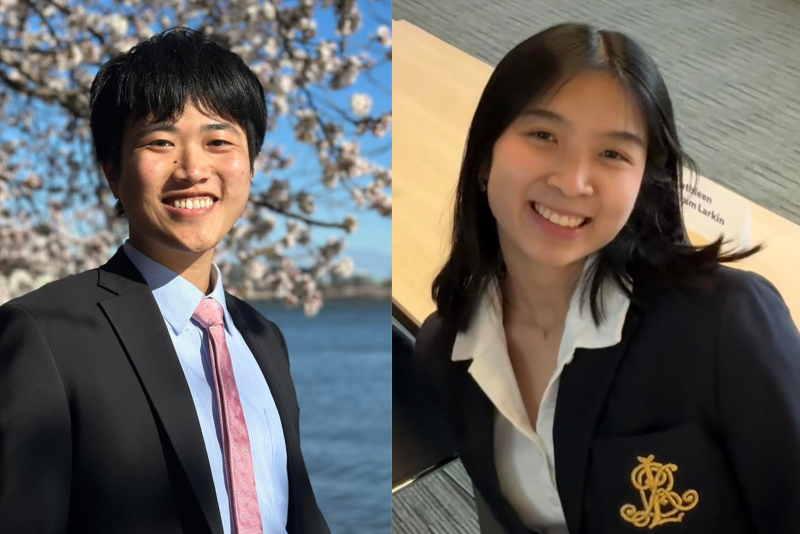
This past Winter quarter, Professor James Lin led a Task Force titled ‘Averting War: Taiwan and US-China Relations.’ Over a period of ten weeks, a team of 14 undergraduates worked together to produce a report with policy recommendations for US and Taiwanese officials, which was presented to David Sacks of the Council of Foreign Relations. We had the opportunity to interview the two editors of this report on their experiences with this Task Force.
Tell us a bit about yourself and how you became interested in Taiwan
Forrest: I am a rising senior studying International Studies, Chinese, and Law, Societies, and Justice. Being part of the Taiwanese diaspora and having visited Taiwan numerous times, I have always been interested in the island’s culture, history, and place in the world. This interest has shaped much of my academic and professional work. Prior to this Task Force, I spent a summer teaching English in rural Taiwan through a program sponsored by the Taiwanese government. I have conducted research on Indigenous Taiwanese cultures, publishing a blog post with the Burke Museum on its cultural holdings coming from the Tao people of Taiwan and presenting research on Paiwan pottery at the 2024 Center of American Indian and Indigenous Studies Research Symposium.
Taking Professor Lin’s course on the history of modern Taiwan was a pivotal moment in my academic career at UW. The course inspired me to not only switch my major to International studies, but also focus my academic interests on Taiwan and China. Being able to participate in this Task Force as an editor and a researcher allowed me to engage with the island from a policy perspective. Working alongside fellow students strengthened my understanding of the island’s place in the world from diverse angles. Together, these experiences have made me more curious about Taiwan, and I look forward to continuing to learn about the island as I spend the upcoming summer there as an intern with the Taiwan Foundation for Democracy.
Melanie: I’m a fourth-year student at the University of Washington, originally from Vietnam. Having lived between different cultures for much of my life, I’ve always been drawn to learning about places with rich and complex cultural identities. Taiwan first caught my attention through my interest in East Asian languages and history, but the more I learned, the more fascinated I became by its unique blend of Indigenous, Chinese, Japanese, and global influences.
My interest deepened in Fall 2025 when I took a course on modern Taiwanese history with Professor James Lin. Through that class, I explored Taiwan’s historical development from the late Qing period through Japanese colonial rule, democratization, and contemporary society. Learning about the historical forces that have shaped Taiwan’s political, cultural, and linguistic landscape gave me a much deeper appreciation for the island’s unique identity and its place in East Asia. The course also introduced me to perspectives and narratives that are often less familiar in Western discussions of the region.
What especially interests me is Taiwan’s multilingual and multicultural society, as well as its vibrant arts, music, and civic culture. Through my studies, I’ve had opportunities to learn more about Taiwanese history and language, which further strengthened my appreciation for the island. I’m excited by the opportunity to experience Taiwan firsthand, learn from local communities, and gain a deeper understanding of a place that I have admired and studied over the past several years.
What insights did you gain on Taiwan’s security situation and position in international politics that you were not aware of until participating in the task force?
Melanie: Through the Task Force, I’ve gained a much deeper understanding of Taiwan’s security situation and its position in international politics. While I was already aware that Taiwan is a sensitive geopolitical issue, I did not fully understand the complexity of cross-Strait relations, deterrence dynamics, and the role of external actors other than the United States. I’ve also gained insight into how Taiwan’s security is shaped not only by military considerations, but also by economic interdependence, domestic politics, and sociocultural factors. This experience helped me appreciate how quickly the strategic environment in the Taiwan Strait can shift, and how nuanced policy analysis must be in response to that uncertainty.
Forrest: Although I was already aware of the importance of Taiwan’s semiconductor industry, I did not realize the extent to which Taiwan is critical to both the US and global economies (As of March 2026, Taiwan is the third largest trading partner the US imports from). This gave me a much deeper understanding of the disastrous economic consequences that could result from a conflict in the Taiwan Strait.
As editors for the Task Force, what skills did you gain that helped with your professional development?
Forrest: The most valuable skills that I developed as an editor for the Task Force were time management, attention to detail, and communication skills. Creating a cohesive analytical product from the works of approximately 15 researchers required me to take on a much more active role than I initially expected. Coordinating deadlines, ensuring consistency across sections, and providing constructive feedback strengthened my organizational and leadership abilities while teaching me how to collaborate effectively within a large team.
Melanie: As editor for the Task Force, I have developed a wide range of skills. One of the most important was analytical editing. Before this, I had no editing experience, let alone any experience in policy writing or editorial work. So I learned how to refine complex policy arguments for clarity, coherence, and impact without losing nuance. I’ve also learned how to give and receive constructive feedback more effectively in a collaborative, deadline-driven environment. Additionally, I have refined my attention to detail when working with dense geopolitical content and have become more confident in engaging with academic and policy-oriented writing.
Perhaps most importantly, I’ve gained significant confidence in engaging with academic and policy-level writing on international security issues. In classroom environments, I have typically been more reserved in discussions and less likely to take on a leadership role, but this experience has pushed me to step more fully into both. I have become more comfortable speaking up, offering input earlier in the process, and taking initiative in group work.
What would you recommend to other students who are thinking about taking this task force t0 prepare for and look forward to?
Melanie: For students considering the Task Force, I would recommend participating. I can say genuinely that few experiences have been as rewarding as this program. You grow significantly and learn a great deal throughout the process. On top of coming in prepared to engage deeply with challenging and fast-moving material, I would also encourage students to have a strong foundational understanding of current events. Being comfortable with dense reading (e.g., think tank reports, congressional testimonies, and academic articles) will make the workload more manageable.
I would also suggest being open to revising your assumptions as you learn and staying flexible in your thinking. Strong writing and communication skills are helpful, but just as important is the willingness to collaborate closely with peers and iterate on feedback. I would encourage students to look forward to the opportunity to work on real-world policy questions and to develop a more layered understanding of one of the most important security issues today.
Very rarely will you get an opportunity like this, and it is worth taking the time to fully appreciate and learn from it. I would recommend that new students put their full effort into this experience, as much as they are able, but also to have fun and enjoy it while it lasts. It’s extremely stressful and time-consuming. Yet it is also so, so, so much fun and worthwhile. Believe it or not, Task Force goes by very quickly, and you may find yourself missing even how busy, fast-paced, and intense it was in the end — I know I did.
Forrest: I would encourage students to come prepared to engage with a large and rapidly growing body of scholarship. Taiwan is one of the most (if not the most) talked about geopolitical issues right now, which means that there is an enormous amount of research, analysis, and debate surrounding the topic. Even after researching this topic for nearly 3 months, I still feel like there is so much more to learn. Students should look forward to developing a deep understanding of the topic through existing scholarship, while also contributing their own meaningful research on a highly relevant global issue.