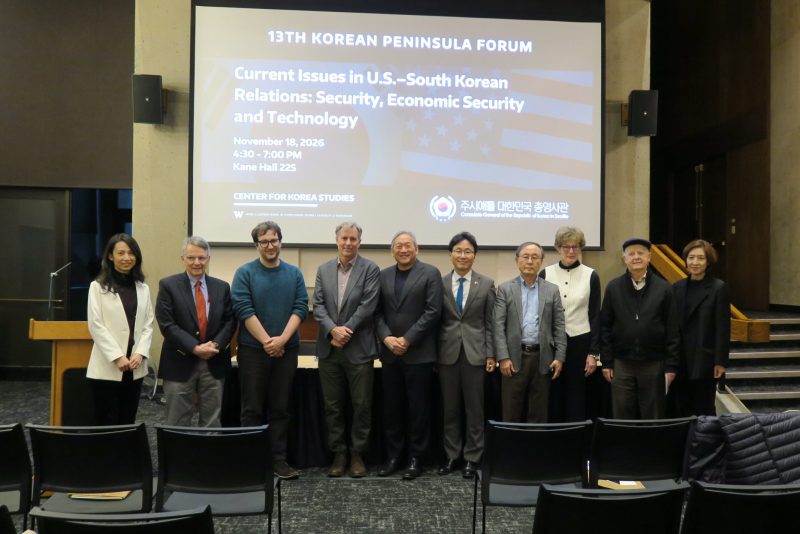
The University of Washington’s Center for Korea Studies (CKS) held its 13th Korean Peninsula Forum on Wednesday, Nov. 18, bringing together diplomats, scholars and industry leaders to examine “Current Issues in U.S.–South Korean Relations: Security, Economic Security, and Technology.”
CKS Director Yong-Chool Ha opened the forum by framing the alliance at a crossroads.
“U.S. foreign policy has shown a growing tendency to move away from alliance commitments traditionally grounded in trust and shared values, while a new strategic alignment among North Korea, Russia, and China is taking shape,” Ha said. “At the same time, the U.S.–South Korea alliance faces the growing challenge of addressing conventional military security and economic security simultaneously.”
Security and diplomacy
Ha then presented remarks on behalf of Ro-byug Park, chairman of the Sejong Institute, who was unable to attend the forum. The presentation outlined six key areas: the evolving strategic landscape, North Korea’s nuclear challenge, the U.S.-ROK bilateral agenda, Seoul’s relations with China and Russia, people-to-people ties, and what these dynamics mean for the alliance’s future.
Ambassador (ret.) Kathleen Stephens built on that foundation with her presentation, “Challenges and Opportunities in U.S.-Korea Relations.” Stephens, who acted as U.S. Ambassador to Korea from 2008 to 2011, now chairs The Asia Foundation’s Board of Trustees.
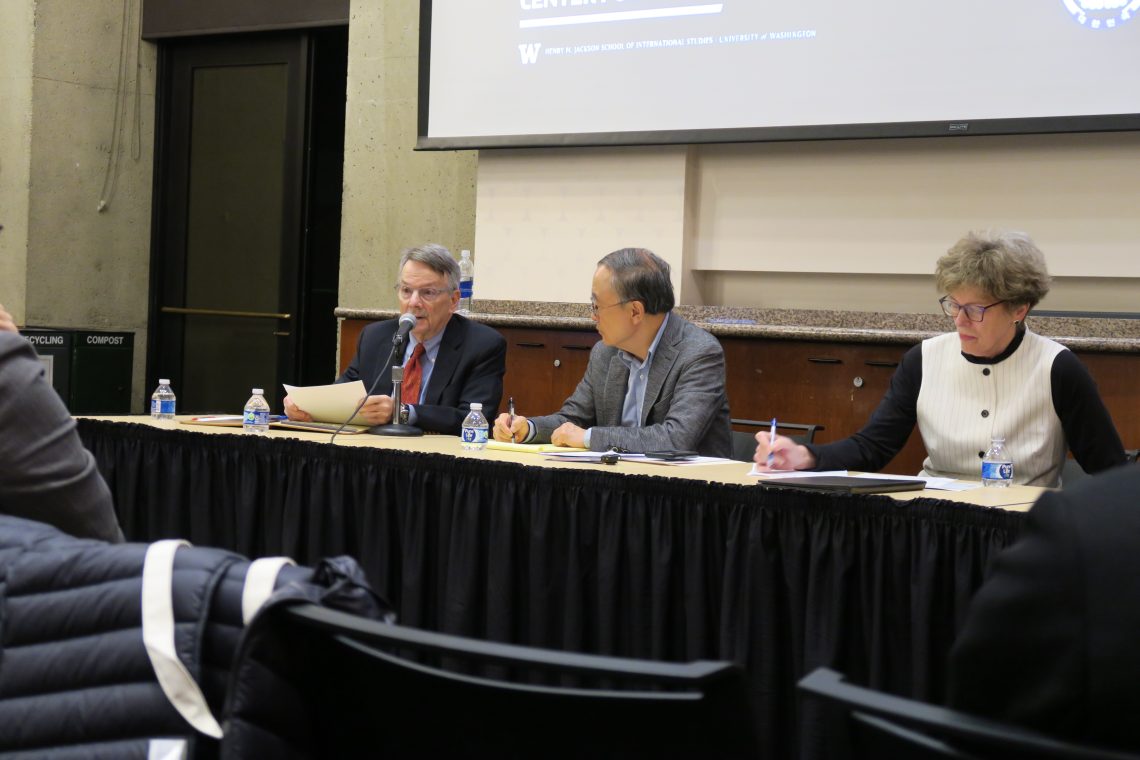
Professor David Bachman responds to remarks from Ambassador (ret.) Kathleen Stephens at 13th Korean Peninsula Forum on Nov. 18, 2026. Photo by Madison Morgan.
Jackson School faculty Daniel Bessner and David Bachman served as discussants for Park and Stephens’ remarks. Bessner is an associate professor at the Jackson School, focusing on the history of U.S. foreign relations; Bachman is currently chair of the UW China Studies Program and brings expertise in foreign policy and international political economy.
Economic ties and technology
Sung Gil Chang, the Consul General of the Republic of Korea in Seattle, examined the “Evolution and Outlook of U.S.-ROK Economic and Trade Relations,” focusing on the interplay between trade, investment and national security. Chang drew on nearly three decades of diplomatic experience, including managing Korea-U.S. Free Trade Agreement negotiations and Trans-Pacific Partnership talks.
“We gather today at a time of significant changes in the global environment,” Chang said. “Geopolitical competition, rapid technological advances, and shifts in the global economic order are increasingly linking economic and technological issues with national security.”
Sung Gil Chang, the Consul General of the Republic of Korea in Seattle presents “Evolution and Outlook of U.S.-ROK Economic and Trade Relations” during the 2026 Korean Peninsula Forum on Nov. 18, 2026. Photo by Madison Morgan.
Hyun Jung “Jessie” Je picked up that economic thread in her presentation, “Building Blocks or Stumbling Blocks for Investment in the United States.” Je currently serves as a senior fellow at the Korea Economic Institute, and was previously the LG Washington Office vice president.
Jackson School Assistant Professor Clair Yang and entrepreneur Edward Jung discussed the presentations by Je and Chang. Yang added perspectives on political economy, asking questions about the tradeoff between economic efficiency and security.
Jung, the co-founder and chief technology officer of Intellectual Ventures, marked a first for the forum: in its 13 years, he was the first non-academic invited to present remarks at the forum. According to Jung, as a Korean-American and the son of immigrants, joining the forum just made sense.
“Korea has always been part of my story even though I grew up in the United States,” Jung said. “I spend an equivalent amount of time in Seoul and Seattle, so a forum that connects the two felt like a natural place to contribute.”
As a discussant, he connected Chang and Je’s security and economic analyses to what he observes in technology markets and investment flows.
“The U.S.-Korea economic relationship is becoming a technology partnership,” Jung said. “Korean investment in America will reach its potential only if it is treated that way rather than as a transaction.”
Looking ahead
Center for Korea Studies Director Yong-Chool Ha talks to attendees of the 13th Korean Peninsula Forum on Nov. 18, 2026. Photo by Madison Morgan.
Following the forum was a reception where attendees continued conversations across government, academia and industry.
“The forum was timely in seeking ways to navigate the alliance through the turbulent period ahead,” Ha said. “Its discussions covered a broad range of interconnected issues, including military security, bilateral economic relations, and increasingly complex global supply chains.”
To learn more about Korean Studies at the UW, visit the Center for Korea Studies website.