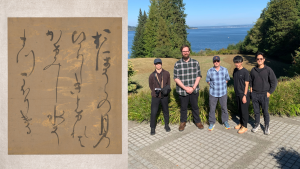
Left: This leaf from Konoe Nobutada’s album Japanese and Chinese Poems to Sing (early 17th century, ink on gold-decorated paper) carries Kokin wakashū 316. Photo courtesy from The Metropolitan Museum of Art. Right: Team photo. From left to right, Takuru Ishikawa, Jeremy Browning, Paul Atkins, Tomo Miyazaki, and Michael R. Zeng
University of Washington Professor Paul Atkins has received funding through the Humanities and AI Virtual Institute (HAVI) to advance research using artificial intelligence to analyze classical Japanese manuscripts. The project aims to make historical texts more accessible while providing scholars with new tools to study Japan’s literary and cultural history.
The project, Deep Learning for Jibo Extraction from Classical Japanese Manuscripts, is led by Atkins in collaboration with Professor Tomo Miyazaki of Tohoku University. By applying deep learning techniques to historical Japanese handwriting, the researchers aim to develop new tools for reading and analyzing manuscripts that have long presented challenges to scholars.
Before the modern Japanese hiragana syllabary was standardized in 1900, scribes could represent individual sounds using multiple written forms known as hentaigana. Each form derives from a Chinese character called its jibo. Identifying these characters can provide valuable information about a manuscript’s origins, including its scribe, historical period, and lineage. However, interpreting these variations by eye is time-consuming and requires specialized expertise.
The project seeks to refine and expand a deep-learning model capable of extracting jibo from digital images of classical Japanese manuscripts and woodblock editions.
The research began unexpectedly when mathematics graduate student Michael R. Zeng approached Atkins about collaborating on a project. Their initial work used statistical analysis of jibo frequencies to challenge the authenticity of a group of well-known manuscripts. Recognizing the method’s potential, they expanded their research with Herman Chau, who earned his Ph.D. in Mathematics in 2025. Together they trained an AI model and used it to label a large collection of manuscript images from the Center for Open Data in the Humanities (CODH) in Japan by jibo, correcting the labels by hand.
Their collaborative paper received the Best Paper Award at the 2025 Jinmonkon symposium on the humanities and computing, where Chau also received the Student Encouragement Award.
The research could have significant implications for Japanese studies. Scholars could use the model to group manuscripts by historical period or scribe and identify connections between texts that might otherwise go unnoticed. The team also plans to make its code and model publicly available, along with a website where users can upload manuscript images to receive transcriptions, jibo statistics, and comparisons with related texts.
“Hundreds of thousands of texts survive from before 1900,” Atkins said. “They were saved and preserved at great cost and effort, but few people can read them now. AI tools are opening this precious archive to a much broader audience, at first to people who can read modern Japanese and eventually beyond that.”
Beyond improving accessibility, the project could help scholars reassess the origins and authenticity of historical manuscripts. Atkins explained that many manuscripts lack signatures, while historical collectors often favored works attributed to prestigious figures, leaving some attributions uncertain.
“We aim to help rebuild the attributions on a firmer foundation than has been seen before,” Atkins said.
The collaboration between the University of Washington and Tohoku University highlights the international and interdisciplinary nature of the research. At Tohoku University, Miyazaki and students Ryo Kondo and Takuru Ishikawa lead the model’s development. At UW, Jeremy Browning, an M.A. student in Asian Languages and Literature, works on acquiring, annotating, and documenting manuscript images, while Zeng leads analytics and development of the public website.
The project was selected for funding through HAVI, an initiative supported by Schmidt Sciences that brings together researchers exploring the intersection of artificial intelligence and the humanities. This year’s awardees were selected by an expert advisory board from a competitive pool of 501 proposals spanning 42 countries. With the latest round of awards, HAVI’s total funding commitment over the past two years has surpassed $21 million.
“The award lets us make the model good enough to trust and open enough that anyone can test it,” Atkins said.
For Atkins, the project also demonstrates how emerging AI technologies can expand opportunities for humanities research. He emphasized that large language models can help scholars write code, process large datasets, test hypotheses, and analyze results, making previously impractical research projects possible.
“They do not just make the work faster. LLMs enable projects that would have been utterly infeasible a year ago,” Atkins said.
Through this project, Atkins and his collaborators hope to demonstrate how AI can complement traditional approaches to Japanese literary and historical scholarship. Their work has the potential to make classical manuscripts more accessible, strengthen historical manuscript attribution, and contribute to a deeper understanding of Japan’s written cultural heritage.
For more information about the Humanities and AI Virtual Institute award, visit the Schmidt Sciences HAVI website.