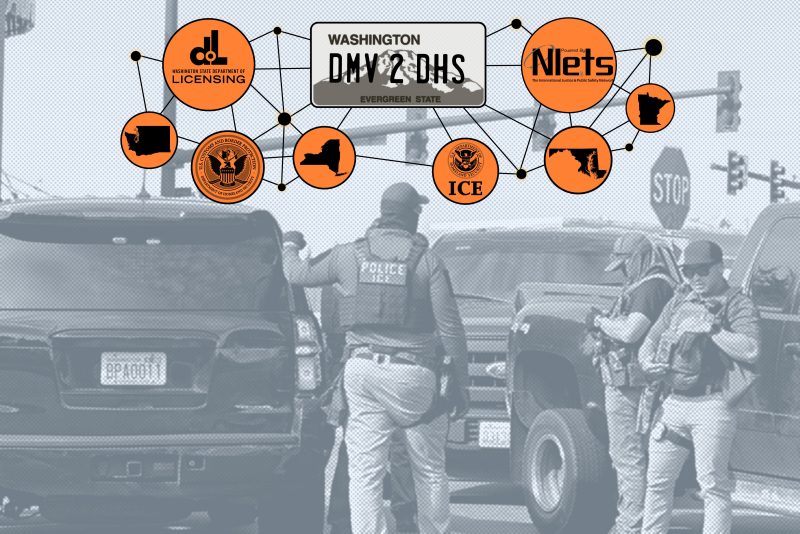
Visit our monthly update page for ongoing information on driver and vehicle data sharing with federal immigration enforcement agencies in Washington state. Download report fact sheets: Report overview (English) Deteniendo la Ruta del DMV-a-DHS (Español) Stopping the DMV-to-DHS Pipeline (English) Executive summary In recent months, traffic stops have become an increasingly frequent, visible, and violent
Between August 2025 and October 13, 2026, UWCHR has verified 356 cases in which immigration arrests occurred following federal agents’ search of license plate numbers in the Washington DOL database via the data-sharing network Nlets. UWCHR researchers have identified 38 unique ORIs associated with these searches. Although state authorities have restricted access to Nlets to
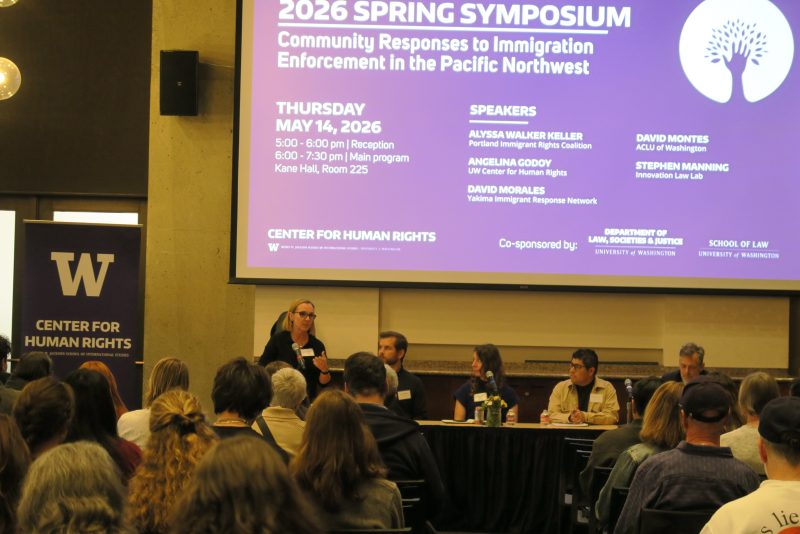
On Thursday, May 14, we hosted our 2026 Spring Symposium featuring UWCHR’s Immigrant Rights Observatory research on Pacific Northwest immigration enforcement trends and how communities are responding to today’s heightened enforcement and changing tactics. We heard from an excellent panel of advocates from across Washington and Oregon including: Alyssa Walker Keller, Portland Immigrant Rights Coalition
This report is part of a series regarding Human Rights Conditions at the Northwest Detention Center in Tacoma, Washington, based on ongoing research efforts and released to highlight initial findings in the urgent context of the COVID-19 pandemic. Contents: • Introduction • Background, Methodology, and Human Rights Standards • Sanitation of Food and Laundry •
At a time when immigration enforcement is both more visible and more secretive than ever before, UWCHR is publishing a new dataset released to us as part of settlement negotiations in ongoing FOIA litigation against DHS. This data, drawn from I-213 forms[1] produced by ICE during 2022 through 2025 in the agency’s Seattle Area of
Washington Department of Licensing (DOL) continues “roadside assists” to ICE/CBP immigration investigations. In this research update to the January 8, 2026, “Roadside Assist” report, UWCHR highlights new cases and analysis of DOL data. New cases: UWCHR’s January 2026 report, “Roadside Assist,” documented 9 cases in which ICE or CBP queried DOL data prior to conducting
Since the release of this report, Washington Department of Licensing data sharing with federal immigration enforcement agencies continues. Visit our monthly update page for more information. Executive summary Today, immigrant Washingtonians are increasingly afraid to drive, as our streets, highways, and public thoroughfares have become frequent sites for immigration enforcement. These incidents, in which drivers
Since our inception, UWCHR has conducted research on topics related to immigrant rights in Washington state, as specified by the state law under which our center was founded. These ongoing efforts are now grouped under our Immigrant Rights Observatory project. Over the years, our reports have documented both serious concern for the rights of migrants
This report is part of a series regarding Human Rights Conditions at the Northwest Detention Center in Tacoma, Washington, based on ongoing research efforts and released to highlight initial findings in the urgent context of the COVID-19 pandemic. Contents: • Introduction • Background, Methodology, and Human Rights Standards • Sanitation of Food and Laundry •
Summary Flock Safety automated license plate reader (ALPR) networks have become increasingly common in Washington state. Records obtained by UWCHR researchers via public records requests reveal that at least eight Washington state law enforcement agencies enabled direct, 1:1 sharing of their networks with U.S. Border Patrol at some point during 2025; effectively opening the “front