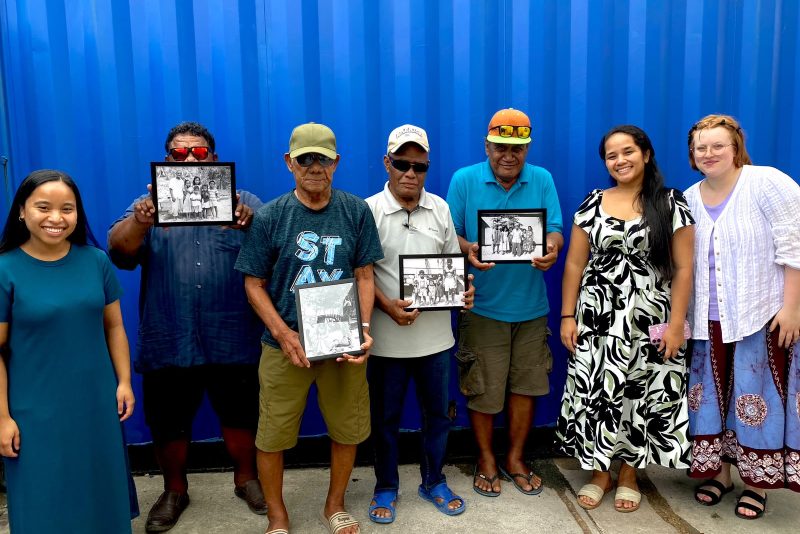
With the support of the Abe Osheroff & Gunnel Clark Fund from the UW Center for Human Rights, I was able to travel to the Marshall Islands, alongside undergraduate research assistant Kayce Malachi, for three weeks to complete the 2026 Rongelap Photo Project—a collaboration between University of Washington students and the National Nuclear Commission of the Marshall Islands (NNC). This project stemmed from the discovery of over a thousand photos in an unprocessed collection held by the University of Washington Special Collections. The majority of these photos were taken at Rongelap Atoll, Republic of the Marshall Islands, between 1955 and 1965, during the University of Washington’s involvement in United States nuclear testing. From this discovery, a project bloomed for the return of photos to the Rongelapese community and the naming of individuals in them.
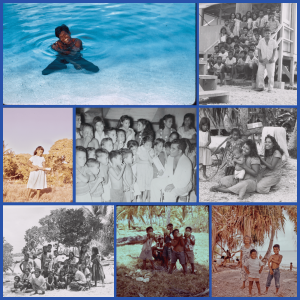
A collage of photos found in an unprocessed collection at the University of Washington Special Collections, taken at the Republic of the Marshall Islands between 1955 and 1965, during the University of Washington’s involvement in United States nuclear testing.
Through this project, we have not only been able to return the photos to the Marshall Islands, but we were also able to bring Kayce Malachi, the project’s research assistant and a Marshallese student, back to visit her home country for the first time while participating in an invaluable research experience. As a non-Marshallese person working with the Marshallese government, it is vital to weave these opportunities into my work to uplift the brilliant Marshallese people around me. In her own words, Kayce reflected on the opportunity:
“The trip has made me realize that the medicine field is definitely the route I want to take to help the community. It made me grateful for the opportunities I’ve had because in Majol [The Marshall Islands] there isn’t much. The elders or people we talked to really don’t tell stories of the events because it’s a very traumatic story; they only talk about the funny moments.”
In addition to the value that this experience had for Kayce, the project was widely successful in returning people’s names to the collection of photographs. Throughout the project, we conducted all our work through both the National Nuclear Commission of the Marshall Islands and the Rongelap Atoll local government. This step was crucial because external researchers and journalists often extract information from communities without proper consent, without going through proper channels, and without providing benefits to the affected communities. With this understanding, we met Rongelap Mayor James Matayoshi before our interviews to get his blessings and advice for the project. We conducted all of our interviews with Rongelap Councilman Jakkien Anjain and Chairwoman Ariana Tibon-Kilma of the NNC to ensure we were respectful and were following proper protocol when working with the survivors. The funding we received increased the culturally customary gifts we brought to the five survivors we worked with and to Councilman Anjain, who supported our work.
Through our visits, we learned the names of 90% of the individuals in photos, along with additional context about family names and stories. Most memorable was how every survivor we worked with had a funny story about the school teacher Emius. In interacting with survivors, it was clear to see the strong interest in the photos and the joy of seeing happy photos of family and friends who are no longer with us. This aspect of the experience we viewed as the biggest success. With most visits by researchers and journalists making survivors relive their trauma for external benefit, I am glad we were able to bring out some joy and fond memories despite the difficult work of returning names to people in photos.
From these discussions, we planned future work using these photographs and the rest of the Marshall Islands-related material at the University of Washington. Community members have a clear interest in easy access to the photos and in incorporating these materials into the NNC’s planned nuclear museum. In the continuation of this work, I will be further documenting and collecting specific materials of interest to the NNC, survivors of nuclear testing, and their descendants with whom we met during this journey. Thanks to the Center for Human Rights, this work moved forward.